If you’ve been searching for child care in Mira Mesa, you’ve probably noticed that some programs call themselves a daycare, some a preschool, and some a children’s center. It’s fair to wonder whether there’s a real difference, or whether it’s just a name on the sign.
The short answer: the difference is less about the label and more about what your child actually does all day. Here’s how to tell, and what to look for when you visit.
The short answer
- Daycare usually means care and supervision while parents work. A good daycare keeps children safe, fed, rested, and happy, often across a long day and a wide range of ages.
- Preschool usually means a planned program of early learning for children of about 2 to 5, with the goal of getting them ready for kindergarten.
- Many programs do both. The best ones combine the hours and care working families need with a real curriculum.
In California, the license doesn’t tell you which one you’re getting
In California, most preschools and daycare centers hold the same kind of license: a child care center license from the state’s Community Care Licensing Division. Both have to meet the same basic rules on safety, staffing, and the number of children per teacher.
That means “preschool” and “daycare” aren’t official categories you can check. The license tells you a center meets the state’s minimum standards. It doesn’t tell you whether your child spends the day learning or mostly being watched. To find that out, you have to look at the program itself.
Tip: you can look up any licensed center, including its capacity and inspection history, on the state’s Community Care Licensing facility search.
How to tell the difference on a tour
These questions show you quickly what kind of program you’re looking at:
- “What does a typical day look like?” Listen for a predictable rhythm with circle time, learning centers, outdoor play, and rest, not just free play and screen time.
- “Is there a curriculum, and who plans it?” A preschool program should be able to tell you what children are learning and why.
- “How do you get children ready for kindergarten?” Look for early literacy, numbers, and problem solving, alongside social and emotional skills like sharing and handling big feelings.
- “How many children are there per teacher?” Smaller ratios mean more attention for your child.
- “How will I know how my child’s day went?” Good programs keep families in the loop.
Do you have to choose?
Not necessarily. Some families assume a preschool means a short, school-year schedule, so they pick a daycare to cover the workday. But many preschools offer full-day care too.
The real question is what matters most for your child right now. For a baby, warm and attentive care comes first. As children grow, a program that adds purposeful learning helps them arrive at kindergarten curious, confident, and ready.
How Magic Hours approaches it: more than daycare, we teach
Magic Hours Childrens’ Center has been part of Mira Mesa since 1972, as the first preschool built in the neighborhood. We’re family-owned, now run by the second and third generations, and from the start we’ve believed young children deserve more than child care.
- Care for working families. We’re open Monday to Friday, 6:45 AM to 5:45 PM, with full-day and half-day options. Full-day students get lunch plus a morning and afternoon snack.
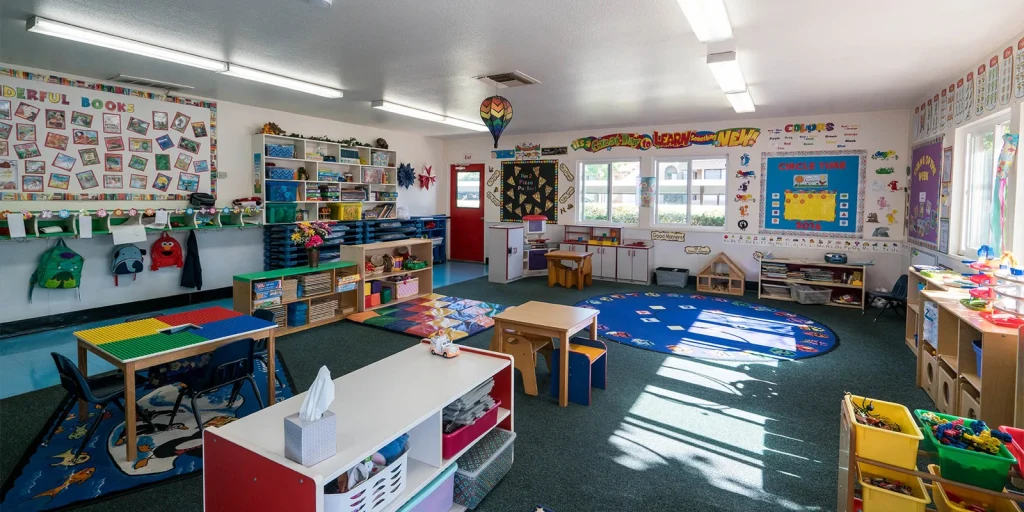
- A real curriculum. Our System Four approach develops children socially, emotionally, physically, and academically, with eight areas of learning every day, from language and literacy to math, science, art, and music.
- A program for every stage. Our Infant and Toddler rooms focus on gentle, attentive care at a 1:4 ratio. Preschool 1, Preschool 2, and Transitional Kindergarten build school-ready skills at a 1:12 ratio.
- Growing with your child. Children can start with us as babies and stay through the year before kindergarten, in the same familiar place.
Curious what a week here actually looks like? Our monthly calendar shows each week’s theme and the books and activities behind it.
Questions parents ask
Is preschool the same as daycare in California?
Not exactly. Most preschools and daycare centers in California hold the same child care center license from the state’s Community Care Licensing Division, so the label alone doesn’t tell you much. The difference is in the program: a preschool follows a planned curriculum that prepares children for kindergarten, while a daycare’s main focus is care and supervision. Many centers, including Magic Hours, offer both.
What age can my child start at Magic Hours?
Our Infant program welcomes babies from 3 months old, and our Toddler program serves children from 12 to 24 months. Preschool starts at age 2 with Preschool 1, followed by Preschool 2 at age 3 and Transitional Kindergarten at ages 4 to 5.
Does my child need to be potty trained for preschool?
Not to start. Preschool 1, for 2 to 3 year olds, welcomes children who are still working on potty training. Preschool 2 is for children who are fully potty trained.
Can preschool cover a full workday?
At Magic Hours, yes. We’re open Monday to Friday from 6:45 AM to 5:45 PM, with full-day and half-day options, so families get school-ready learning and the hours they need for work.
Are meals included?
Yes. Full-day toddler and preschool students get lunch plus a morning and afternoon snack, and half-day students get a snack. In the Infant room, feeding follows each baby’s own schedule.
See the difference for yourself
The best way to understand any program is to visit. Tour our classrooms, meet our teachers, and picture your child here.
← Back to Home